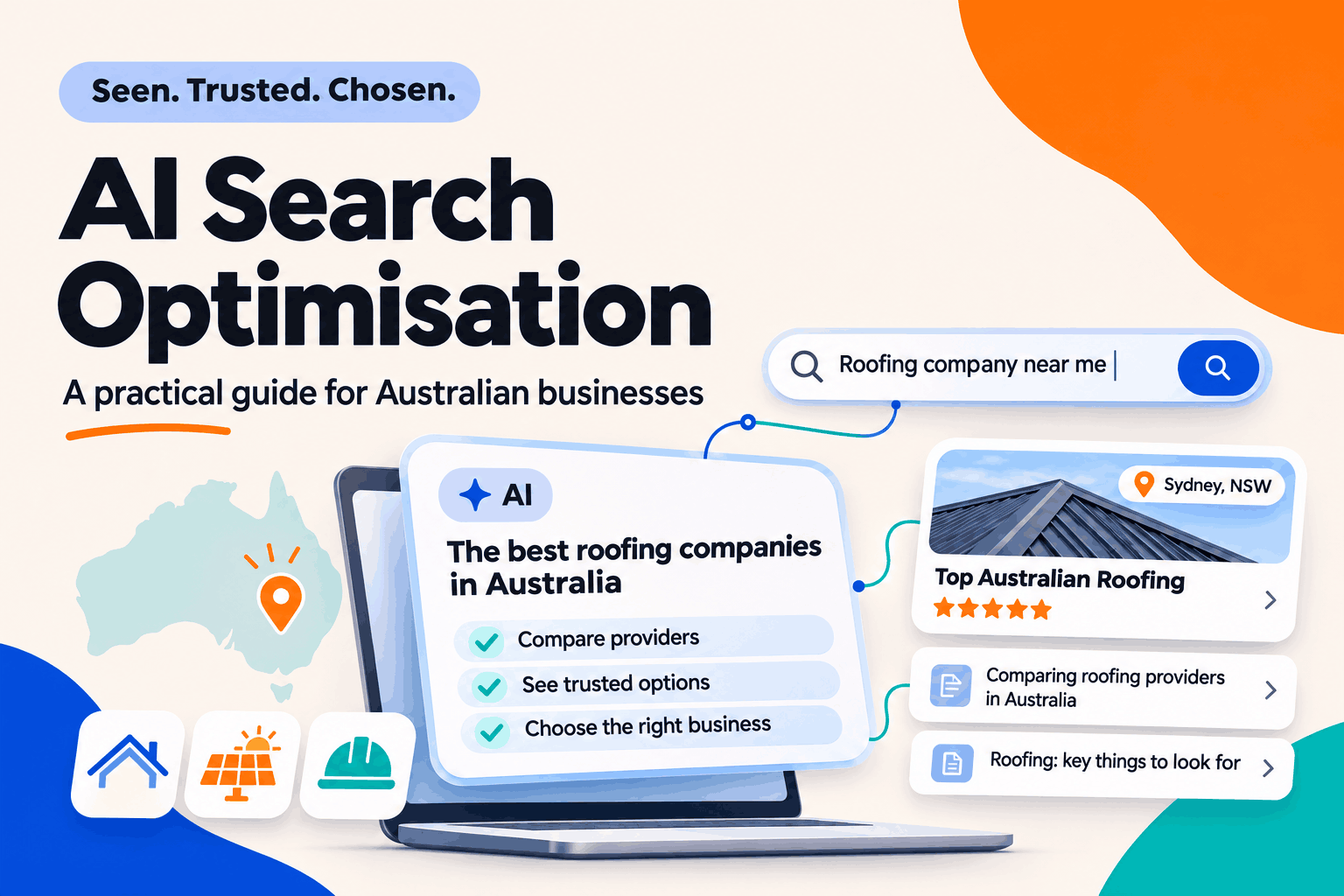
AI Search Optimisation: A Practical Guide for Australian Businesses
A homeowner on the Gold Coast needs a roofer. Instead of scrolling through a list of websites, they ask ChatGPT which local roofing companies are worth considering and what questions to ask before accepting a quote.
Meanwhile, a business owner in Brisbane uses Google AI Mode to compare digital marketing agencies. Another customer asks an AI assistant to explain the difference between two solar systems before contacting an installer.
These are examples of how AI-powered search can become part of the way customers discover and evaluate businesses.
For Australian companies, the challenge is no longer limited to ranking for the right keywords. It’s also about making sure accurate, useful information about your business is available when customers research their options through AI.
That’s where AI Search Optimisation comes in.
AI Search Optimisation is the process of improving your website, content and wider online presence to support visibility in AI-powered search experiences, including Google AI Overviews, AI Mode and ChatGPT Search.
It builds on established search engine optimisation rather than replacing it.
At Quokka Collective, we focus on connecting search visibility with meaningful business outcomes. That means helping customers find the information they need, understand what makes a business relevant and take the next step.
This guide explains how AI search works, what the official guidance recommends and how Australian businesses can build a practical optimisation strategy without wasting money on unproven tactics.
What Is AI Search Optimisation?
AI Search Optimisation involves making information about a business easier for AI-powered search systems to access, understand, retrieve and potentially reference.
In traditional search, customers typically enter a query, review results and choose which websites to visit.
AI-powered search can provide a more conversational experience. Users may ask detailed questions, compare options and refine their research through follow-up prompts.
For example, someone looking for an air conditioning contractor might ask:
“Which type of air conditioning system is better for a two-storey home in Brisbane, and what should I check before choosing an installer?”
A useful response may explain system types, installation considerations, common costs and questions to ask a contractor, with supporting links where available.
For businesses, this creates opportunities to be discovered through the information customers use to make decisions.
However, appearing in an AI-generated answer is not guaranteed.
Different platforms use different information sources, retrieval methods and ranking processes. A business that appears in one response might not appear in another.
SEO, GEO, AEO and AI SEO: What’s the Difference?
Several terms are used to describe search optimisation in the AI era.
| Term | Meaning | Main Objective |
|---|---|---|
| SEO | Search Engine Optimisation | Improve organic search visibility |
| GEO | Generative Engine Optimisation | Improve how content may be represented in generative AI responses |
| AEO | Answer Engine Optimisation | Make information useful for answering relevant questions |
| AI SEO | Search optimisation in an AI-influenced environment | Connect traditional SEO with emerging AI search experiences |
These approaches have considerable overlap.
Google’s official documentation explains that generative AI features in Google Search continue to depend on its established search ranking and quality systems.
In other words, improving technical accessibility, content quality and the usefulness of your website remains relevant.
AI Search Optimisation is best understood as an extension of your existing search strategy, not a separate collection of shortcuts.
How Does AI Search Actually Work?
Understanding the basic process helps explain why some websites become useful sources for AI-generated responses.
Google AI Overviews and AI Mode
Google’s generative search features use its search infrastructure to retrieve relevant information and help produce answers.
Two techniques described in Google’s official documentation are particularly relevant.
Retrieval-Augmented Generation (RAG): A process in which relevant information is retrieved and used to help generate a grounded response.
Query fan-out: A technique where an AI system performs multiple related searches to investigate different aspects of a question.
For example, someone asking about installing a swimming pool in Queensland may need information about construction costs, pool types, council requirements and ongoing maintenance.
The system may look for information related to several of those subjects rather than relying on a single keyword search.
For business owners, the implication is practical.
Your website should address relevant customer questions accurately and connect related information in a logical way.
ChatGPT Search
ChatGPT Search can retrieve online information and provide links to relevant sources.
OpenAI’s publisher guidance explains that website owners should allow its search crawler, OAI-SearchBot, to access content they want to make eligible for inclusion.
This also means checking whether a firewall or content delivery network is blocking legitimate crawler requests.
Allowing access supports eligibility for discovery. It does not guarantee that ChatGPT will cite or recommend your business.
Bing and Microsoft Copilot
Microsoft also provides AI-powered search experiences and reporting tools.
Bing Webmaster Tools includes AI Performance reporting that can help publishers understand how their content appears as citations in supported AI experiences.
These reporting capabilities can provide additional information beyond conventional search clicks.
Why the Differences Matter
A business may appear in Google Search without being cited by ChatGPT.
An informational article may be referenced as a source without the business itself being recommended as a service provider.
And a business can be mentioned without receiving a clickable link.
These are different outcomes.
A useful AI search strategy should distinguish between search rankings, source citations, brand mentions, website visits and customer enquiries.
Why AI Search Optimisation Matters for Australian Businesses
Many Australian services involve a substantial research process before the customer gets in touch.
Homeowners may compare builders, roofing contractors, solar installers and pool companies.
Property owners may investigate local real estate agencies before requesting an appraisal.
Business owners may compare accountants, legal practices and marketing providers before booking a consultation.
AI search can become another stage of those buying journeys.
Example: A Roofing Company on the Gold Coast
Imagine two roofing companies.
The first has a homepage containing broad promotional statements, a short services list and a phone number.
The second explains its roof inspection process, the types of repairs it undertakes, its actual service areas, relevant qualifications and what homeowners should consider before accepting a quote.
It also has genuine project examples and useful information about common roof problems.
The second website gives customers more relevant material for evaluating the business.
It may also provide search systems with clearer information about its services.
That doesn’t guarantee a recommendation, but it creates a stronger foundation for discovery and trust.
Example: A Real Estate Agency in Brisbane
A real estate agency might publish clear information about its suburbs, appraisal process, property management services and local market conditions.
A generic article about why property is a good investment would be less useful to a seller who wants to compare agents in a specific suburb.
The lesson is to build content around the decisions your customers actually make.
How to Optimise Your Website for AI Search: 9 Practical Steps
There is no single AI optimisation technique that works universally.
Instead, businesses should prioritise improvements that make their information accurate, accessible and useful.
1. Fix Your Technical SEO Foundations
Before publishing new content, check whether your most important pages are accessible to search engines.
Review:
- Google indexing status
- Robots.txt rules
- Page-level indexing directives
- Canonical URLs
- Server errors and redirect problems
- Internal links
- JavaScript-rendered content
- Mobile usability and page performance
For Google’s generative search features, pages generally need to satisfy the relevant Search eligibility requirements, including indexing and snippet eligibility.
Being technically eligible does not guarantee that a page will be selected.
For ChatGPT Search, review whether OAI-SearchBot can access the relevant content.
If your website uses aggressive bot protection, check that legitimate search crawlers aren’t inadvertently blocked.
A technically healthy website is the starting point for both conventional SEO and AI-focused search work.
2. Make Your Business Easy to Identify
Can a customer quickly understand what your business does, where it operates and who it serves?
This sounds simple, but many websites rely on vague language.
Consider these two examples.
Vague description:
“We provide exceptional solutions for your property needs.”
Clear description:
“We provide roof leak inspections, roof restoration and gutter replacement for residential properties across the Gold Coast.”
The second example identifies the services, audience and location.
Useful business identity information includes your trading name, services, actual service areas, contact details, qualifications and experience.
Keep that information consistent across your website and relevant business profiles.
If you’re specifically interested in appearing in conversational results, read our guide to making your business easier to discover and verify through ChatGPT.
3. Understand What Your Customers Ask AI
Traditional keyword research remains useful, but customers often ask AI tools longer, more detailed questions.
Compare these searches:
Traditional search: “pool builders Brisbane”
Conversational search: “Should I choose a concrete or fibreglass pool for a small backyard in Brisbane, and what might affect the cost?”
Both are relevant to a pool-building company, but they represent different stages of research.
The first may indicate an intention to find a provider.
The second suggests the person is still evaluating options.
For effective content planning, organise customer questions into three categories:
Understanding a problem: What is happening, why does it matter and what are the possible solutions?
Comparing options: What are the differences, costs, limitations and trade-offs?
Choosing a provider: Who offers the service, where do they operate and what should customers check before making contact?
These categories can help connect blog articles to the right commercial pages.
4. Publish Information That Adds Genuine Value
Google’s guidance for generative AI search places particular emphasis on original, helpful content that offers value beyond information widely available elsewhere.
For a construction company, this might mean publishing a real project breakdown explaining:
- The customer’s requirements
- The scope of work
- Challenges encountered
- Relevant material or design decisions
- The completed outcome
- Lessons useful to future customers
For a solar installer, valuable content might compare system options using accurate specifications and practical installation considerations.
For a real estate agency, original local market observations may be more useful than generic property advice.
The objective is not to produce the highest number of articles.
It’s to publish information that a reader would genuinely value even if search engines didn’t exist.
Where appropriate, include original images, relevant diagrams or videos that help explain the topic.
5. Create Connected Content Around Important Topics
A single article can’t answer every question about a complex service.
A connected content structure helps visitors explore a subject in more detail.
For example, a roofing business might organise content around roof repairs.
Its service page could explain the available repair services and how customers request an inspection.
Supporting articles could address:
- Signs of roof water damage
- Roof repair versus replacement
- What happens during a roof inspection
- Factors affecting repair costs
- Common roofing materials used in Queensland
These articles should link naturally to relevant services and to one another where useful.
The benefit is a more coherent website that supports different stages of the customer journey.
You don’t need to create a separate article for every slight variation of a question.
Google specifically warns against producing large volumes of near-duplicate content primarily to manipulate rankings or AI search appearances.
6. Strengthen Local SEO and Business Profiles
For many Australian businesses, local relevance matters more than broad national visibility.
A homeowner searching for an emergency electrician in Southport needs a company that actually services Southport.
A business looking for an HVAC contractor in Brisbane needs accurate information about coverage and capabilities.
Google’s official AI search guidance identifies Google Business Profile as an important way to maintain business details that may be used across Search experiences.
Local optimisation priorities include:
- An accurate Google Business Profile
- Correct contact information
- Appropriate business categories
- Genuine service areas
- Relevant business hours
- Authentic customer reviews
- Useful location-specific pages
- Clear information about local projects and services
Avoid creating dozens of nearly identical pages that only replace one suburb name with another.
If a location page exists, it should have a distinct purpose and provide useful information about the services actually offered there.
For trades and home-service businesses, the objective is to attract enquiries from the areas they genuinely serve.
7. Use Structured Data Appropriately
Structured data can help supported search systems understand particular information on your website.
Depending on the page, relevant schema types may include:
- Organisation or LocalBusiness
- Service
- Article or BlogPosting
- Product
- BreadcrumbList
However, schema markup should accurately describe information visible on the page.
Adding structured data doesn’t force ChatGPT, Gemini or Google AI Overviews to recommend your company.
Google’s official guidance also states that special schema markup isn’t required to appear in its generative AI search features.
The purpose of structured data is clarity and eligibility for supported search enhancements, not manufacturing authority.
8. Build Credibility Beyond Your Own Website
Customers may hear about your business before visiting its website.
They might encounter a review, an industry publication, a business directory or a recommendation from another professional.
For an Australian service business, credible recognition may come from:
- Relevant professional associations
- Legitimate industry directories
- Local publications
- Genuine customer reviews
- Partnerships with related businesses
- Expert commentary
- Original research or useful resources
For example, a roofing company contributing expert advice to a relevant renovation publication may reach customers already researching home improvements.
A property agency publishing useful local market analysis may create opportunities for other websites to reference that information.
These activities can support reputation and referral visibility.
But buying artificial mentions or low-quality links to manipulate AI answers is not a reliable long-term strategy.
9. Make It Easy for Visitors to Enquire
Visibility is useful only when it supports your business goals.
Imagine an AI-generated answer links to your website, but the visitor can’t find your phone number, the contact form fails or the service page doesn’t explain how to request a quote.
The discovery opportunity has been wasted.
Review your website from a customer’s perspective.
Can visitors understand your service within seconds?
Is the next step obvious?
Does the website work properly on mobile?
Are forms short and functional?
Can customers find information about service coverage, qualifications and pricing arrangements where relevant?
A well-designed website turns useful information into a better customer experience.
This is why website design and search visibility should be planned together rather than treated as separate projects.
AI Search Optimisation Checklist
Before investing in advanced tactics, use this checklist to review one important service page.
| Area | What to Check | Priority |
|---|---|---|
| Technical access | Page is accessible, indexable where intended and free of critical errors | High |
| Business identity | Services, locations and contact details are accurate | High |
| Page content | Main customer questions are answered clearly | High |
| Internal linking | Related services, useful articles and contact options are connected | High |
| Trust | Claims, qualifications and examples are verifiable | High |
| Local visibility | Business profiles and service areas are accurate | High for local businesses |
| Structured data | Markup is appropriate and matches visible content | Medium |
| AI measurement | Relevant citations, mentions and referrals are monitored | Medium |
| Conversion | Visitors can easily request a quote or make an enquiry | High |
Complete the high-priority items before investing heavily in experimental AI optimisation techniques.
What Doesn’t Work? Common AI SEO Myths
The growth of AI search has created plenty of speculative advice.
Some techniques may have specific applications, but they shouldn’t be presented as universal ranking methods.
Myth 1: You Need an llms.txt File to Appear in Google AI Search
Google’s official guidance states that it doesn’t use llms.txt files for visibility in Google Search, including generative AI features.
Other tools may use such files for specific purposes, but adding one is not a substitute for established SEO.
Myth 2: Every Paragraph Must Be a Specific Length
There is no universal paragraph or content-chunk size that guarantees inclusion in AI-generated answers.
Write for the reader.
Use clear headings, logical sections and explanations that match the complexity of the subject.
Myth 3: You Need Separate Pages for Every AI Prompt
Creating many pages that answer slight variations of the same question can lead to repetitive, low-value content.
A comprehensive, well-organised resource is often more useful than numerous near-duplicate pages.
Myth 4: Schema Markup Guarantees AI Recommendations
Schema can support accurate interpretation and certain search features.
It doesn’t guarantee a citation or recommendation in an AI response.
Myth 5: Getting Mentioned by AI Automatically Means More Sales
A brand mention may create awareness without generating a website visit.
A citation may send a visitor who never becomes a customer.
Measure visibility alongside enquiries, conversions and other commercial outcomes.
How to Measure AI Search Visibility in 2026
AI search measurement should distinguish between several outcomes.
Search visibility: Is your website appearing in relevant conventional search results?
AI citation: Is your page linked as a supporting source in an AI-generated response?
Brand mention: Is your business named in the answer?
Referral traffic: Does a visitor arrive from an identifiable AI platform?
Business outcome: Does the interaction contribute to a meaningful enquiry, lead or sale?
These metrics shouldn’t be treated as interchangeable.
Google Search Console
Google has introduced reporting for performance in its generative AI search experiences.
Website owners should review the available Generative AI reporting alongside standard Search Console performance data.
Use the information to understand which content is attracting visibility and whether performance trends are changing.
Bing Webmaster Tools
Bing’s AI Performance reporting provides additional insight into content citations across supported Microsoft AI experiences.
Depending on feature availability, reporting can include citation-related metrics and comparisons.
Google Analytics 4
GA4 can help identify some referral visits from AI-powered platforms.
However, not every AI-assisted discovery results in a measurable referral.
A customer may first discover your company through an AI response and later return through a direct visit or branded search.
Manual AI Visibility Monitoring
Choose a consistent set of questions that real customers might ask.
For example:
- Which roofing companies service the Gold Coast?
- What should I look for in a Brisbane solar installer?
- How do I compare real estate agents in Southport?
- What matters when choosing an accountant for a small business in Queensland?
Run the same questions at regular intervals and record:
- Whether your business appears
- Whether your website is cited
- Which competitors appear
- Whether the information is accurate
- Whether the response changes over time
- These observations are directional rather than definitive.
AI responses can vary depending on the platform, user context, location and time.
The goal is to identify patterns, not declare success based on a single screenshot.
A 30-Day AI Search Optimisation Action Plan
You don’t need to change your entire website at once.
A focused first month can establish the foundations and reveal where improvements are most valuable.
Week 1: Audit Your Website and AI Visibility
Review your most important service pages and technical SEO issues.
Check Google indexing, crawler access, business details, current search performance and the way relevant AI tools describe your business.
Record the starting position.
Deliverable: A prioritised audit identifying technical barriers, missing business information and content gaps.
Week 2: Improve Your Core Commercial Pages
Choose the pages most closely connected to enquiries and sales.
Improve service descriptions, real service-area information, useful FAQs, contact options and relevant internal links.
Add evidence supporting important business claims.
Deliverable: Improved pages that clearly explain the services customers are most likely to enquire about.
Week 3: Publish Supporting Content
Use customer questions, keyword research and information gaps to select relevant topics.
For example, a Gold Coast roofing business might publish a comparison of roof restoration and roof replacement, while a Brisbane solar installer could create a guide to choosing a system for different household needs.
Link the articles to the appropriate commercial pages.
Deliverable: A small number of original, useful resources that support real customer decisions.
Week 4: Strengthen External Signals and Set Up Reporting
Review business profiles, relevant directories and authentic customer feedback.
Configure available search reporting and establish a repeatable process for evaluating selected AI queries.
Check organic enquiries and referral traffic.
Deliverable: A baseline report covering organic search, selected AI visibility observations, referral traffic and customer enquiries.
After 30 days, the objective isn’t to claim guaranteed AI rankings.
It’s to have a more accessible website, stronger information and a measurable plan for ongoing improvement.
SEO and GEO: Why Australian Businesses Need Both
Customers don’t think in separate marketing channels.
They might discover a company through Google Maps, research its services through an AI assistant, check its reviews and eventually visit its website.
A useful digital strategy connects those experiences.
Traditional SEO helps improve organic discoverability.
GEO considers how relevant, credible information may be represented in generative AI responses.
Website design helps customers understand the offer and take action.
Brand consistency and external credibility support trust throughout the journey.
At Quokka Collective, our GEO and AI search services build on established SEO principles while addressing the changing ways customers find and evaluate businesses.
The aim isn’t to chase every AI mention.
It’s to help more of the right customers discover, understand and choose your business.
Frequently Asked Questions About AI Search Optimisation
What is AI Search Optimisation?
AI Search Optimisation is the process of improving a website and wider business information to support discovery and potential inclusion in AI-powered search experiences. It builds on traditional SEO foundations, content quality, accessibility and credibility.
What is the difference between SEO and AI Search Optimisation?
SEO primarily focuses on organic search visibility. AI Search Optimisation also considers how information may be retrieved, summarised or referenced in AI-powered responses. Many practical techniques overlap.
Can I make my business appear in ChatGPT?
You can make your public business information accurate, useful and accessible to relevant crawlers, including OAI-SearchBot for ChatGPT Search eligibility. However, there is no guaranteed method for securing a particular recommendation.
How do I optimise my website for Google AI Overviews?
Start with Google’s established SEO guidance: accessible and eligible pages, helpful original content, strong technical foundations and accurate business information. Google doesn’t require special AI-only schema or an llms.txt file.
Does AI Search Optimisation work for local businesses?
It can be relevant to local businesses because customers may use AI tools to research services and compare providers. Accurate Google Business Profile details, useful service pages, genuine reviews and clear service areas are sensible priorities.
Does structured data improve AI search rankings?
Appropriate structured data can help supported search systems interpret information and qualify for some features, but it doesn’t guarantee AI inclusion or improved rankings.
How long does AI Search Optimisation take?
There is no fixed timeframe. Results depend on the starting condition of the website, competition, technical accessibility, content quality and the platforms being measured. Improvements should be evaluated over time alongside business outcomes.
Can Google Search Console measure AI search performance?
Google provides reporting for generative AI search experiences within Search Console. Businesses should use the available reports alongside conventional organic search metrics and other sources of performance data.
Is GEO worth investing in for small Australian businesses?
It can be worth exploring, especially where customers research and compare providers before contacting them. The sensible starting point is strong SEO, clear commercial pages and useful content rather than expensive unproven techniques.
Get Found Where Your Customers Are Looking
Search is changing, but customers still need the same things: useful information, credible businesses and a straightforward way to make contact.
AI-powered search introduces new ways to research and compare providers.
For Australian businesses, the opportunity is to strengthen online visibility without losing sight of what matters commercially.
At Quokka Collective, we connect SEO, AI search, useful content and website experience around the customers you want to reach.
Whether you’re a roofer on the Gold Coast, a service company in Brisbane or a growing business operating across Australia, the first step is understanding where your digital presence can improve.
Talk to the Quokka Collective team about building a practical search strategy that supports qualified enquiries and sustainable growth.