Key takeaways
-
- No one can guarantee a ChatGPT recommendation, but you can make your business easier to discover, describe and verify.
-
- Strong SEO foundations still come first: crawlable pages, a dedicated page per service and accurate local listings.
-
- Replace vague claims with specific, checkable facts about what you do, where and how.
-
- Track AI mentions with a fixed set of prompts each month, and keep mentions, citations and accuracy separate.
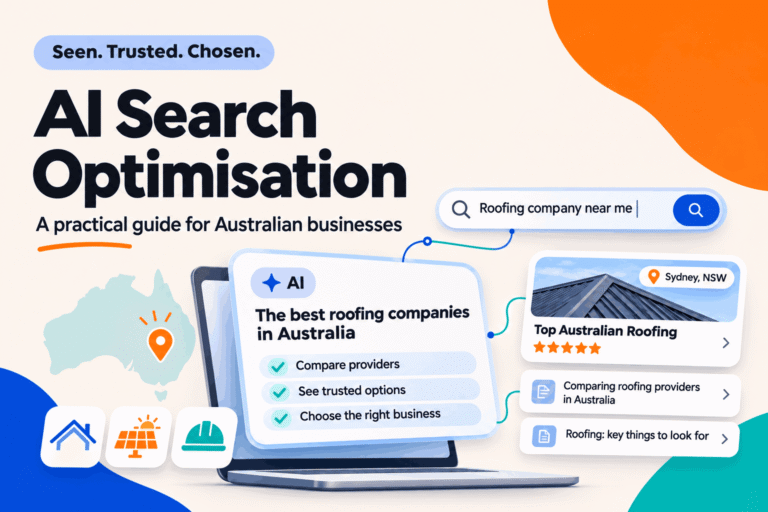
A potential customer asks ChatGPT to suggest a roofing company on the Gold Coast. Another asks Google whether a local property manager handles holiday rentals. If your business is relevant, will these tools find accurate information about what you do, where you work and why a customer should consider you?
That is the question behind AI search optimisation. No form guarantees a ChatGPT recommendation. You can, however, make your business easier to discover, describe and verify. Here is where to start.
How AI Search Discovers and References Businesses
Traditional search presents results for people to compare. AI search can assemble an answer from retrieved information, sometimes with linked sources. ChatGPT Search may search the web; Google’s AI Overviews and AI Mode retrieve supporting pages through search systems. Methods differ by platform.
That distinction matters because three outcomes are often confused:
-
- Appearing in a search result: your page or business listing is available as a result.
-
- Being cited: an AI response links to your page as supporting information.
-
- Being mentioned or recommended: the response names your business, perhaps without linking to your website.
A business might be mentioned without receiving a citation, or its article might be cited without the business being recommended. Neither outcome is guaranteed simply because a page is published or indexed.
Technical access is the starting point. OpenAI’s guidance on ChatGPT Search says website owners should allow OAI-SearchBot to crawl their site and ensure hosting or security systems do not block its published IP ranges. Google has separate crawling and indexing requirements for its search features. Allowing a bot access makes discovery possible; it does not secure placement.
Information also comes from outside your website: public business profiles, reputable directories, industry organisations and genuine reviews. No published formula assigns each a fixed weight in ChatGPT recommendations.
AI responses can be incomplete or wrong. Customers should still confirm qualifications, service areas, availability and other important details directly with the business.
Why Strong SEO Foundations Still Matter
Generative engine optimisation (GEO) concerns representation in AI answers. It does not replace search engine optimisation (SEO).
Google’s official guidance on generative AI search states that established SEO practices remain relevant. For a page to qualify as a supporting link in Google’s generative search features, it must meet applicable search eligibility requirements, including indexing and snippet eligibility. ChatGPT Search has its own discovery systems, so Google indexing alone should not be treated as proof of ChatGPT inclusion.
Start by checking whether your important pages can be accessed by the relevant crawlers. Review robots.txt, page-level indexing directives, server errors and any firewall rules that block legitimate bots. Make sure essential descriptions are available in readable page content, especially if your site relies heavily on JavaScript.
Structure the site around customer needs:
-
- Provide a dedicated, genuinely useful page for each major service rather than hiding everything in one paragraph.
-
- Write specific page titles and headings that identify the service and, where relevant, the location.
-
- Use contextual internal links between your homepage, service pages, relevant guides and contact details.
-
- Check mobile usability, page speed, navigation and the visibility of key contact information.
-
- Keep your Google Business Profile and other legitimate local listings accurate.
For example, a Gold Coast roofing company might need separate pages explaining roof leak repairs, roof restoration and emergency call-outs, with the actual suburbs covered stated clearly. A single page repeating “best roofers Gold Coast” offers much less practical information.
Structured data such as LocalBusiness and BlogPosting should match visible content. It cannot force AI inclusion; Google requires no special GEO schema.
The aim of sound SEO foundations is to make the website useful and accessible before adding AI-specific measurement.
Building Clear, Credible and Useful Content
Customers cannot assess services that a business barely explains online. Neither can AI systems reliably describe them.
Begin with the questions people ask before making contact: What is included? Which areas are serviced? Who performs the work? How are quotes prepared? What restrictions or qualifications apply? Answer these directly on the most relevant service page, then use supporting articles for subjects that genuinely need more detail.
Replace Vague Claims With Usable Information
Consider this hypothetical Gold Coast plumbing business.
Before: “We are your trusted local plumbing experts, offering quality service and affordable solutions for all your needs.”
After: “We carry out blocked drain inspections, leaking tap repairs and hot water system replacements for homes in Southport, Labrador and Biggera Waters. Our service page explains which jobs require an on-site inspection, what information to provide when requesting a quote, and how to arrange an appointment.”
The improved version tells a customer what the business does and where. It also creates statements that can be checked against its actual services. The business should only publish those statements if they are true.
A conveyancing practice could explain whether it assists buyers or sellers, its jurisdiction and the stages of a matter. A real estate agency could clarify its management areas and rental appraisal process.
For substantial advice, identify a genuine author or reviewer and relevant qualifications. Support important claims with verifiable examples or primary sources, not vague superlatives.
Keep business identity consistent across the website, Google Business Profile and relevant third-party listings. A consistent trading name, contact number, address where applicable and service area reduce confusion. Encourage authentic reviews and correct outdated listings; do not purchase mentions or manufacture endorsements.
Helpful FAQs can resolve genuine decision-making questions, but adding an FAQ section or FAQ schema does not guarantee inclusion in an AI answer. Different industries and service types need different answers.
AI Search Content Readiness Checklist
Use this checklist on one commercially important service page before expanding it across the website:
-
- Check access: confirm the page opens without login, server errors or unwanted crawler blocks.
-
- Check indexing: inspect its Google indexing status and intended canonical URL.
-
- Name the service: make the title, main heading and opening paragraph specific.
-
- Define the area: list genuine suburbs, regions or delivery boundaries where relevant.
-
- Answer real questions: include at least three questions drawn from enquiries, calls or sales conversations.
-
- Prove important details: verify licences, qualifications, examples and service claims before publishing.
-
- Connect the page: add working links to related services, relevant guidance and a contact route.
-
- Check identity: compare the page’s business information with current profiles and listings.
These checks identify verifiable improvements, not a universal “AI readiness score”.
Tracking Brand Mentions in AI Search
To assess how to appear in ChatGPT search, first document what relevant prompts currently return. Treat this as observation, not a ranking report.
Create 10–15 prompts reflecting discovery, comparison and service questions. Keep wording consistent between tests.
Record whether your brand appears, whether your domain is cited, which competitors are named and whether the description is accurate. Separate a brand mention from a linked citation. Repeat tests monthly with the platform, date, location settings and relevant search mode recorded.
Illustrative example only — hypothetical observations, not actual AI search results:
| Search Prompt | AI Platform | Brand Mentioned | Citation URL | Date |
|---|---|---|---|---|
| SEO agencies serving the Gold Coast | ChatGPT Search | Quokka Collective | https://quokkacollective.com/services/seo/ | 1 Oct 2026 |
| SEO agencies serving the Gold Coast | Google AI Mode | No | — | 1 Oct 2026 |
Add a separate competitor-mentions column to your own tracking sheet.
Measure three things over time: mention coverage (prompts in which your brand appears divided by prompts tested), citation coverage (prompts citing your website divided by prompts tested), and accuracy (mentions that describe your business correctly). These are internal observational metrics, not platform-issued rankings.
For traffic, check the AI Assistant channel in Google Analytics 4, alongside identifiable referral sources and enquiries. This channel covers recognised AI-assistant referrals; it excludes visits attributed to Google’s AI Overviews and AI Mode. A mention without a click will not appear as a referral visit.
Google Search Console offers a Generative AI performance report for eligible Google search experiences, while Bing Webmaster Tools’ AI Performance report provides citation and grounding-query insights for supported Microsoft AI experiences. Neither is a complete dashboard of all ChatGPT mentions, and the services measure different things.
Results vary with wording, location, search mode, personalisation and model updates. A change in observed mentions does not prove that one edit caused it.
Common AI Search Optimisation Mistakes
Many GEO mistakes come from treating uncertain outcomes as if they were controllable ranking factors. The fixes are usually straightforward.
-
- Replacing SEO with GEO: maintain crawlability, useful service pages, internal links and local SEO while adding AI visibility checks.
-
- Expecting guaranteed recommendations: set objectives around accessibility, accurate representation and measured observations, not promised ChatGPT placements.
-
- Publishing generic AI-written articles at scale: interview subject experts and add useful service details, original explanations and checked examples before publishing.
-
- Ignoring technical barriers: test crawler access, indexing, mobile rendering and broken links before rewriting dozens of pages.
-
- Treating schema as a shortcut: use accurate structured data that matches visible content; do not add irrelevant markup in the hope of forcing citations.
-
- Using unsupported statistics or invented proof: trace claims to primary sources and remove unverified awards, performance figures or testimonials.
-
- Judging success from one prompt: use a stable prompt set across multiple dates and record competing brands and cited URLs.
-
- Neglecting customer experience: keep opening hours, contact details, service boundaries and enquiry paths accurate and usable.
Be cautious, too, about paid “AI mention packages”, compulsory llms.txt files or special formatting rules advertised as guaranteed routes into AI answers. Google’s documentation does not require llms.txt or any dedicated GEO markup for its search features. Other platforms may use different approaches, so assess each recommendation against current documentation and a demonstrable business need.
The most useful starting point is a service-page audit: can a person quickly establish what you offer, where you operate and why your information is credible? If the answer is no, fix that before chasing an AI visibility score.
For Australian businesses seeking a practical approach across search experiences, book a conversation with Quokka Collective. We can discuss the SEO, website content and digital marketing priorities that would make your business easier to find, understand and trust—without promising where an AI platform will place it.