SEO Is Dead. Or Not?
SEO is dead.
You’ve probably heard it before. Social media was supposed to kill it. Paid advertising was going to replace it. Then came voice search, and now artificial intelligence has taken over the conversation.
This time, though, the concerns aren’t entirely unfounded.
Google can answer questions before someone clicks a website. ChatGPT can recommend businesses without showing a traditional list of search results. Customers can compare products, research services and narrow down their options without visiting ten different websites.
For businesses that have spent years investing in organic traffic, that’s a significant change.
But does it mean search engine optimisation (SEO) no longer works?
No. SEO isn’t dead. The relationship between search visibility, website traffic and business growth is changing.
The strategies that delivered results five years ago won’t necessarily produce the same outcomes today. Ranking first is still valuable, but it doesn’t guarantee the clicks, enquiries or sales that businesses once expected.
To understand what works in 2026, we need to separate what’s genuinely changing from what’s simply another dramatic headline.
Why Is Everyone Saying SEO Is Dead?
The argument isn’t new. SEO has been declared dead repeatedly as search engines, algorithms and online behaviour have evolved.
What makes the current debate different is the way artificial intelligence is changing the search experience itself.
For years, the typical journey was straightforward:
- Someone searched for a product, service or answer.
- Google displayed a selection of websites.
- The user clicked a result.
- The website provided information and attempted to convert that visitor into a customer.
That journey still exists. But it’s no longer the only way people discover businesses.
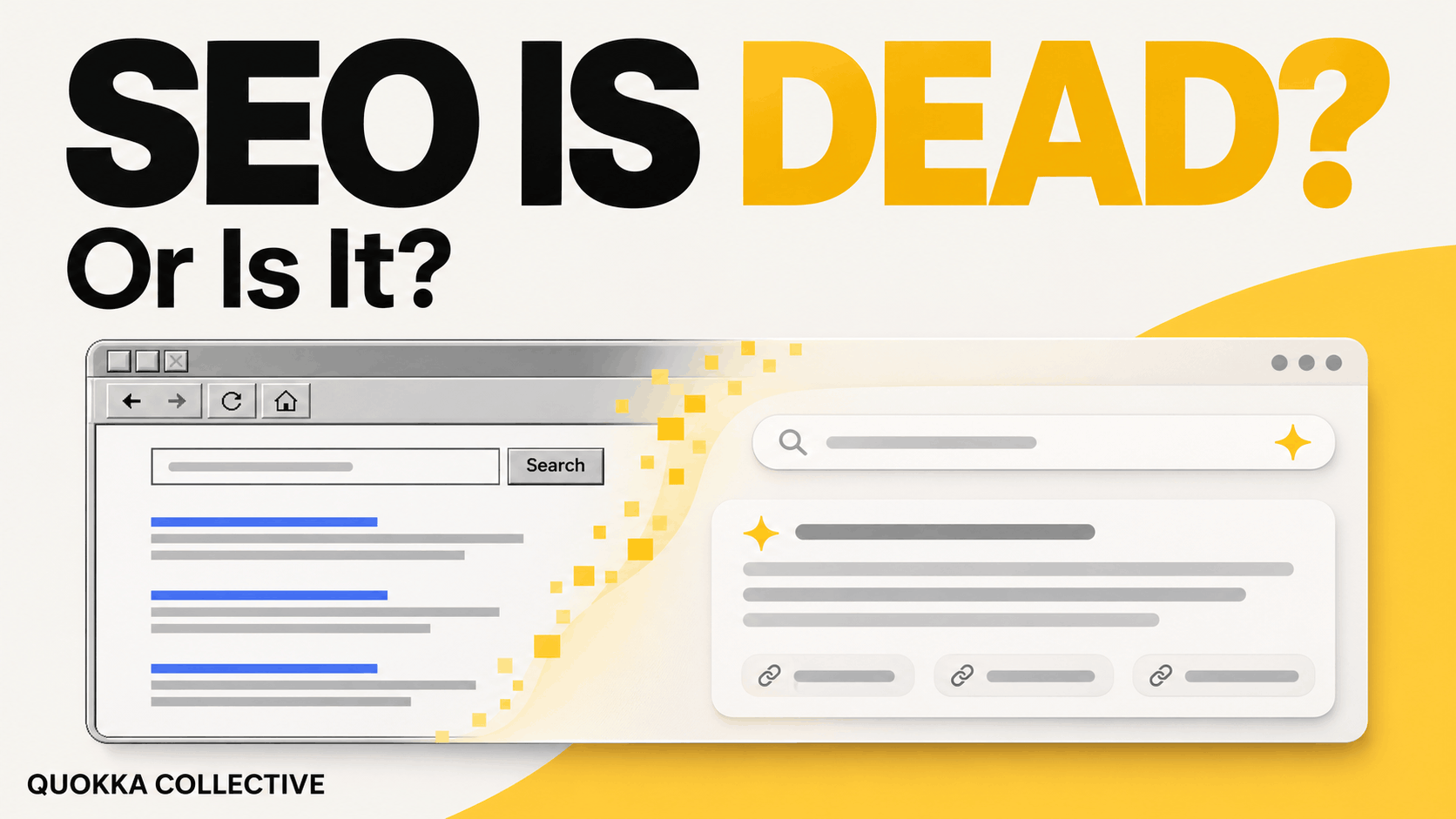
Google AI Overviews and AI Mode can bring information together directly within search. ChatGPT Search can retrieve information and provide an answer with supporting links. Other AI-powered tools offer conversational recommendations based on increasingly detailed questions.
The customer may get enough information to make progress without immediately visiting a business’s website.
This is the underlying issue behind much of the concern about SEO.
The Evidence Behind Declining Search Clicks
The impact isn’t purely theoretical.
A 2025 Pew Research Center study found that Google users clicked a traditional search result in 8% of visits where an AI summary appeared, compared with 15% of visits without one.
That doesn’t mean every website lost half its traffic. The study examined specific observed browsing behaviour, not the performance of every industry or search query.
It does, however, demonstrate an important change: appearing in search results doesn’t always translate into a website visit.
For publishers and businesses built around high-volume informational queries, that distinction matters.
A website answering straightforward questions may face more competition from the answers appearing directly in search.
A business offering a specialised service, on the other hand, may still attract customers who need to compare providers, assess qualifications, request a quote or book an appointment.
The effect depends on what people are searching for and what they need to do next.
What Has Actually Died in SEO?
SEO itself hasn’t disappeared. Several assumptions behind older SEO strategies have become much less reliable.
1. Publishing More Articles Doesn’t Automatically Mean More Traffic
There was a time when businesses could expand organic traffic by producing large numbers of articles targeting closely related keywords.
Some of those articles offered genuine value. Others simply repeated information already available across hundreds of websites.
Today, producing generic content is easier than ever.
AI tools can generate a basic explanation of almost any common topic in seconds. Search engines can also provide direct answers to many of those questions.
Publishing another article that says exactly what everyone else has already said gives people little reason to choose your website.
What matters is the information you contribute.
Original examples, real experience, detailed comparisons, clear explanations and answers grounded in your actual services are more useful than content created merely to fill a keyword gap.
2. Ranking Number One No Longer Guarantees Attention
A traditional organic result can compete with advertisements, maps, product listings, videos, featured snippets and AI-generated answers.
Even when a page ranks well, its position on the screen and the context surrounding it can affect whether someone clicks.
That doesn’t make rankings irrelevant.
It means rankings need to be interpreted alongside click-through rates, actual enquiries and commercial outcomes.
A business ranking for a highly relevant service query may generate better opportunities than one attracting thousands of visitors through broad educational articles.
3. Keyword Repetition Is Not a Content Strategy
Repeating a search phrase throughout a page doesn’t demonstrate expertise.
Modern search optimisation needs to account for the underlying question, the user’s circumstances and the information required to make a decision.
A Gold Coast homeowner searching for a roof restoration company may want to understand the process, suitable roof types, likely considerations, service coverage and whether an inspection is needed.
A page repeating “best roof restoration Gold Coast” doesn’t answer those questions.
A useful service page does.
Keywords still matter because they help connect your content with demand. They simply need to be part of a broader understanding of search intent.
4. Traffic Alone Is No Longer a Useful Definition of Success
A business can increase its organic sessions without increasing its revenue.
It can also experience fewer visits while receiving more relevant enquiries.
Neither scenario tells the full story until the quality of the traffic and the commercial outcome are examined.
The old assumption that more traffic automatically means more business is no longer sufficient.
SEO should be measured by the opportunities it creates, not only the visitors it attracts.
SEO vs GEO vs AEO: What’s the Difference?
One reason the conversation has become confusing is the number of new terms being introduced.
SEO, GEO and AEO are often presented as separate disciplines competing for the same marketing budget.
In reality, they overlap considerably.
| Term | Meaning | Primary focus |
|---|---|---|
| SEO | Search Engine Optimisation | Making websites discoverable, useful and competitive in organic search |
| GEO | Generative Engine Optimisation | Improving how a brand and its information are represented in AI-generated answers |
| AEO | Answer Engine Optimisation | Making information clear and useful for systems that respond directly to questions |
SEO: The Foundation
SEO includes technical accessibility, site structure, content quality, internal linking, relevant external references, local visibility and the experience people have when they reach your website.
These fundamentals remain important.
In its guidance on generative AI search, Google explains that established SEO practices remain relevant to its AI search features.
A poorly organised website with inaccessible pages, unclear services and unreliable information doesn’t suddenly become competitive because a business adds an AI-related service to its marketing plan.
GEO: Visibility Beyond Traditional Search Results
GEO focuses on how information about a business appears in generative AI experiences.
For example, an Australian business owner might ask ChatGPT to recommend a digital marketing agency that understands local SEO for roofing companies.
The answer may include business names, descriptions and supporting sources.
From a business perspective, the objective is to make its services, expertise and identity easier to discover and verify.
That includes keeping information accurate across the website and relevant third-party sources, publishing useful content and developing a credible online presence.
However, no business can guarantee a recommendation from ChatGPT or a citation from another AI system.
AEO: Answering the Question Properly
AEO is concerned with delivering information in a way that directly addresses a question.
This might include explaining the differences between two services, clarifying eligibility requirements or providing a practical answer before going into additional detail.
But answer-focused writing isn’t a reason to turn every paragraph into a short FAQ.
Good content still needs context, explanation and evidence.
The most useful approach isn’t choosing between SEO, GEO and AEO. It’s making sure your business can be found, understood and trusted wherever relevant discovery happens.
How AI Search Is Changing Customer Behaviour
AI-powered search doesn’t simply change where content appears. It can also change how customers research their options.
From Short Keywords to Detailed Questions
A customer might previously have searched:
“SEO agency Gold Coast”
Now, that same person might ask:
“Which SEO agency on the Gold Coast works with construction businesses and can help generate more qualified local enquiries?”
The second query provides more context.
It reveals the customer’s industry, location and desired outcome.
Businesses that clearly explain whom they serve, what they do and how their services work are better positioned to be understood in these more specific searches.
That doesn’t mean creating a separate page for every imaginable question.
It means covering the important topics and customer needs within a sensible, well-connected website structure.
From Searching for Information to Evaluating Businesses
AI can help people understand a topic before they contact a provider.
A potential customer may already know the difference between local SEO and technical SEO, have a shortlist of agencies and understand the questions they want to ask.
The website then needs to do more than provide a definition.
It needs to demonstrate capability.
Relevant services, experience, clear deliverables, case studies and an accessible contact process become especially important when a visitor is closer to making a decision.
From One Search Platform to Several
Google remains an important part of online discovery, but customers can also encounter businesses through AI assistants, maps, video platforms, social media and industry publications.
These channels are not interchangeable.
A Google Maps result may help someone find a nearby service. A detailed comparison article may support a business decision. A video may demonstrate how a product works. An AI-generated answer may help someone shortlist possible providers.
A practical digital strategy considers which channels are genuinely relevant to its audience rather than attempting to appear everywhere.
Does Google Still Matter in 2026?
Absolutely.
The arrival of generative AI doesn’t mean people have stopped using Google to find local businesses, compare services, search for products or navigate directly to websites.
Google also continues to operate its traditional search results alongside its AI-powered features.
What’s changed is the relationship between visibility and clicks.
Some informational searches can be answered directly. Other searches still require users to visit websites, compare options, book services or complete transactions.
For Australian service businesses, local search is particularly important.
A homeowner looking for an emergency plumber in Brisbane or a pool builder on the Gold Coast still needs a real provider capable of delivering the service.
An AI summary cannot repair a pipe, inspect a roof or build a swimming pool.
The business providing that service still needs to be discoverable, credible and easy to contact.
Local SEO Is Still a Commercial Priority
For businesses serving specific areas, strong local visibility involves more than ranking a blog article.
Important foundations include an accurate Google Business Profile, location-relevant service content, genuine customer reviews, clear contact details and a usable mobile website.
Businesses with multiple service areas should explain where they actually operate.
Creating dozens of nearly identical location pages without useful local information is not a substitute for demonstrating real coverage or expertise.
Local SEO remains valuable because geographic relevance and the ability to deliver a service continue to influence customer decisions.
What Does Good SEO Look Like Now?
An effective SEO strategy in 2026 needs to connect traditional search fundamentals with the realities of AI-driven discovery.
Here are the priorities worth focusing on.
1. Build a Technically Accessible Website
Search systems need to discover, access and understand your content.
Start with the basics:
- Check important pages for indexing and crawling problems.
- Review robots.txt and unintended access restrictions.
- Fix broken internal links and incorrect redirects.
- Make important service information available in readable page content.
- Improve mobile usability and unnecessary loading delays.
- Use canonical URLs appropriately.
- Keep navigation and internal linking logical.
- Apply accurate structured data where relevant.
For ChatGPT Search, website owners should also review whether OAI-SearchBot can access their public content.
Allowing access doesn’t guarantee a mention or recommendation. It simply removes one possible barrier to discovery.
2. Make Every Important Service Clear
A website shouldn’t leave customers guessing what a business actually offers.
Give commercially important services dedicated pages when they represent distinct customer needs.
For example, a renovation company may need separate pages for bathroom renovations, kitchen renovations and complete home renovations.
Those pages should explain the work involved, relevant service areas, common project considerations, the process and how customers can request an enquiry.
The goal is not to create the maximum number of pages.
It’s to make each important service understandable and useful.
3. Publish Content That Competitors Can’t Easily Replicate
The internet doesn’t need another generic article explaining that good customer service matters.
It benefits from information that helps someone make a better decision.
Consider content based on:
- First-hand project experience.
- Real customer questions.
- Original photographs and demonstrations.
- Practical comparisons.
- Clearly explained processes.
- Verified performance results.
- Common mistakes observed during actual work.
- Industry-specific considerations.
A roofing contractor might explain why two apparently similar roof restoration jobs require different preparation.
A dental practice might explain the factors affecting treatment suitability without making unrealistic guarantees.
An accounting firm might clarify a business-specific process using current Australian requirements.
These examples offer more substance than broad claims about being experienced or trustworthy.
4. Establish a Consistent Business Identity
Search visibility isn’t limited to the words on your homepage.
Your business may also be represented through profiles, relevant directories, industry associations, independent reviews and publications.
Keep your business name, services, contact information and service areas accurate.
Where possible, support meaningful claims with genuine evidence.
If you publish case studies, explain the challenge, work completed and actual results. Avoid inventing testimonials, awards or statistics.
Credibility matters to people making purchasing decisions, regardless of which platform helped them discover you.
5. Improve the Website Experience After the Click
A search result can introduce someone to your business. Your website still needs to earn their enquiry.
Make it straightforward to understand your services, compare options and take the next step.
A strong page should have a clear purpose, helpful information, readable formatting and an appropriate call to action.
Long contact forms, confusing navigation and vague descriptions can create friction even when search visibility is strong.
Effective web design and SEO should support the same commercial goals.
6. Treat AI Visibility as an Additional Measurement Area
If potential customers are using AI tools to discover providers, it’s reasonable to observe whether your business appears in relevant responses.
Create a small collection of representative prompts.
Record whether your brand is mentioned, whether your website is cited, what competitors appear and whether your business is described accurately.
Repeat observations over time using consistent testing conditions.
These observations can help identify gaps, but they aren’t official rankings.
AI answers may vary by wording, location, platform, search mode and other conditions.
Don’t promise guaranteed placements, and don’t treat one successful prompt as proof of a successful campaign.
How Should Businesses Measure SEO Success Now?
Rankings, impressions and organic sessions still provide useful information.
But they shouldn’t be the only measures of success.
A clearer approach connects search performance with business outcomes.
| Metric | What it tells you |
|---|---|
| Organic search visibility | Whether relevant pages are appearing in search |
| Non-branded search queries | Whether new audiences are finding the business |
| Qualified organic enquiries | Whether search is generating relevant opportunities |
| Enquiry conversion rate | Whether visitors are taking useful actions |
| Booked appointments or quotes | Whether enquiries progress towards a sale |
| Revenue from organic leads | Whether search contributes measurable business value |
| AI brand mentions and citations | Whether the brand is observed in relevant AI responses |
| Branded search demand | Whether people are actively searching for the business by name |
Google Search Console can help identify search queries, clicks, impressions and changes in page performance.
Google Analytics 4 can help assess website interactions and conversions when configured correctly.
A customer relationship management system can provide the missing connection between an initial enquiry and a completed sale.
Attribution will never be perfect. A customer might discover a business through an AI answer, later search its name on Google and eventually make a phone call.
That makes consistent lead-source recording and sensible interpretation more valuable than relying on one dashboard.
A Practical Example
Consider two hypothetical Australian service businesses.
Business A publishes dozens of general articles and attracts 10,000 organic visits. Most visitors are researching topics unrelated to its paid services. It receives five qualified enquiries.
Business B attracts 2,000 organic visits through targeted service pages, suburb-specific content and useful comparisons. It receives 40 qualified enquiries.
The second business has less traffic but a more productive lead-generation channel.
These figures are illustrative, not measured industry benchmarks.
The lesson is that traffic quality and commercial intent need to influence how SEO performance is evaluated.
Is SEO Still Worth the Investment for Australian Businesses?
For many businesses, yes.
But the answer depends on the business model, market, website condition, competition and goals.
A local trade business, an ecommerce retailer and a professional services firm won’t need identical strategies.
When SEO Can Be Particularly Valuable
SEO can be worthwhile when customers actively search for your services, you operate in identifiable markets, your website can convert relevant traffic and the potential value of new customers justifies ongoing investment.
A Brisbane electrician might prioritise local service searches and Google Business Profile visibility.
A Gold Coast law firm might focus on practice-area pages, local relevance and clear explanations of legal services.
An ecommerce business may need stronger product information, category architecture, structured data and shopping-related search visibility.
For businesses investing in professional SEO services, the strategy should reflect customer demand and commercial priorities rather than a generic checklist of tasks.
When SEO Might Not Be the First Priority
SEO shouldn’t automatically receive the largest marketing budget.
A newly launched business with no clear offer, weak demand or an untested conversion process may need to validate its positioning first.
A company relying on immediate enquiries might benefit from a coordinated paid advertising strategy while longer-term organic visibility develops.
A business with a technically functional website but poor customer follow-up may gain more from fixing its sales process before expanding content production.
SEO works best as part of a wider business strategy, not as an isolated promise of traffic.
Should Businesses Stop Blogging Because of AI?
No. They should become more selective about what they publish.
A blog can still answer customer questions, demonstrate specialist knowledge, support service pages and create useful internal linking opportunities.
But content needs a purpose.
Before publishing an article, ask:
- Who is this information for?
- What decision or problem does it help with?
- Does it offer something useful beyond a generic AI answer?
- Which relevant service or next step should readers understand?
- Can the information be supported and kept current?
An article that answers a genuine buying question may deserve investment even if its estimated search volume is modest.
A generic article that attracts large numbers of irrelevant readers may contribute little to the business.
Publishing less content with greater relevance and depth can be a more sensible strategy than maintaining a high-volume schedule without clear outcomes.
What About Backlinks? Do They Still Matter?
Relevant links remain part of the broader search ecosystem, but link building needs to be approached carefully.
A genuine mention or link from an industry publication, local organisation or relevant business partner can help people discover a brand and may support its visibility.
Buying large volumes of irrelevant links or manufacturing endorsements is a different proposition.
Digital PR, useful resources, partnerships and original research can create legitimate reasons for other websites to reference a business.
The objective should be to earn relevant recognition, not simply accumulate links.
Brand mentions and backlinks are also not interchangeable.
A business can be discussed without receiving a link, and a linked page can be cited without the business being recommended.
Neither outcome guarantees visibility in an AI response.
Can You Guarantee That ChatGPT Will Recommend a Business?
No.
Businesses should be cautious about agencies promising guaranteed placements in ChatGPT, Google AI Overviews or other generative search experiences.
AI platforms don’t provide a universal, fixed ranking formula that marketers can manipulate to secure a recommendation.
There are sensible ways to improve technical accessibility, information quality and brand consistency.
Those improvements can make a business easier to find and understand.
They cannot guarantee what an AI system will say for every query.
Similarly, adding an FAQ section, creating an llms.txt file or applying a specially labelled GEO schema is not a guaranteed shortcut.
Google does not require dedicated GEO markup or special AI text files for its generative search features.
Treat claims about secret AI ranking techniques with the same scrutiny you’d apply to promises of guaranteed Google rankings.
A Practical 90-Day SEO and AI Search Plan
Businesses don’t need to rebuild their entire marketing strategy overnight.
A structured review can reveal where the most useful opportunities exist.
| Period | Priority | Key actions |
|---|---|---|
| Days 1–30 | Audit and prioritisation | Review technical SEO, search performance, commercial pages, conversions, competitors and relevant AI visibility |
| Days 31–60 | Strengthen important pages | Improve priority service pages, local information, internal links, content accuracy and enquiry pathways |
| Days 61–90 | Expand and measure | Publish high-value supporting content, strengthen credible external references, review lead quality and repeat AI visibility observations |
This is a practical implementation framework, not a guarantee of improved rankings or enquiries within 90 days.
Some businesses may see improvements relatively quickly. Others will require longer-term work, particularly in competitive markets.
The key is to focus on measurable progress and make decisions from actual business data.
Frequently Asked Questions
Is SEO really dead in 2026?
No. SEO remains relevant, but its role has expanded. Businesses need to consider traditional organic search, AI-powered discovery, website quality and actual conversions rather than relying exclusively on rankings and traffic.
Will ChatGPT replace Google Search?
AI assistants are changing how people find and evaluate information, but there is no basis for assuming Google Search has disappeared or will be replaced completely. Different platforms serve different needs, and businesses should prioritise the channels their customers actually use.
Is GEO replacing SEO?
No. GEO focuses on visibility in generative AI responses, while SEO covers the broader foundations of search visibility. The two overlap substantially. Technical accessibility, useful content and credible business information remain relevant to both.
Are keywords still important for SEO?
Yes. Keywords help identify customer demand and search intent. However, repeating exact phrases isn’t a substitute for answering questions thoroughly and creating pages that meet genuine customer needs.
Does blogging still help SEO?
Yes, when articles provide useful information, address relevant search intent and support the wider website. Publishing large volumes of repetitive or generic content is unlikely to be a strong long-term strategy.
Should small businesses invest in SEO or paid advertising?
The right balance depends on demand, competition, budget and the need for immediate enquiries. Paid advertising can support short-term visibility, while SEO can help establish a longer-term organic presence. Many businesses benefit from using both strategically.
How do I know if my business appears in AI search?
Test a consistent set of relevant customer questions across suitable AI search platforms. Record mentions, citations, competitor appearances and description accuracy. Treat these as observations rather than fixed rankings.
SEO Isn’t Dead. The Old Expectations Are.
Search is changing, and businesses need to change the way they approach visibility.
The goal is no longer simply to rank for as many keywords as possible.
It’s to appear when relevant customers are researching a problem, demonstrate why your business deserves consideration and make the next step easy.
That requires strong SEO foundations, accurate business information, genuinely useful content, a well-designed website and an understanding of how AI is influencing discovery.
At Quokka Collective, we focus on connecting search visibility with meaningful business outcomes.
Whether you’re reviewing an existing SEO strategy or considering how AI search may affect your business, the starting point is the same: understand where your customers are searching, what they need and how your website can better serve them.
Book a conversation with Quokka Collective to discuss your website, SEO priorities and opportunities for sustainable growth.